 Bespoke made in 10-12 weeks
  National Installation
  Worldwide Shipping

A green kitchen has stopped being the brave choice. Green runs through many of our recent projects, from pale sage to deep olive. Searches tell the same story. In 2025 more people in the UK looked up green kitchens than blue, black, pink, white, grey or navy ones.
Here is why green has stuck when other colours came and went, the shades our clients are choosing, and how to pick one for the light in your room.
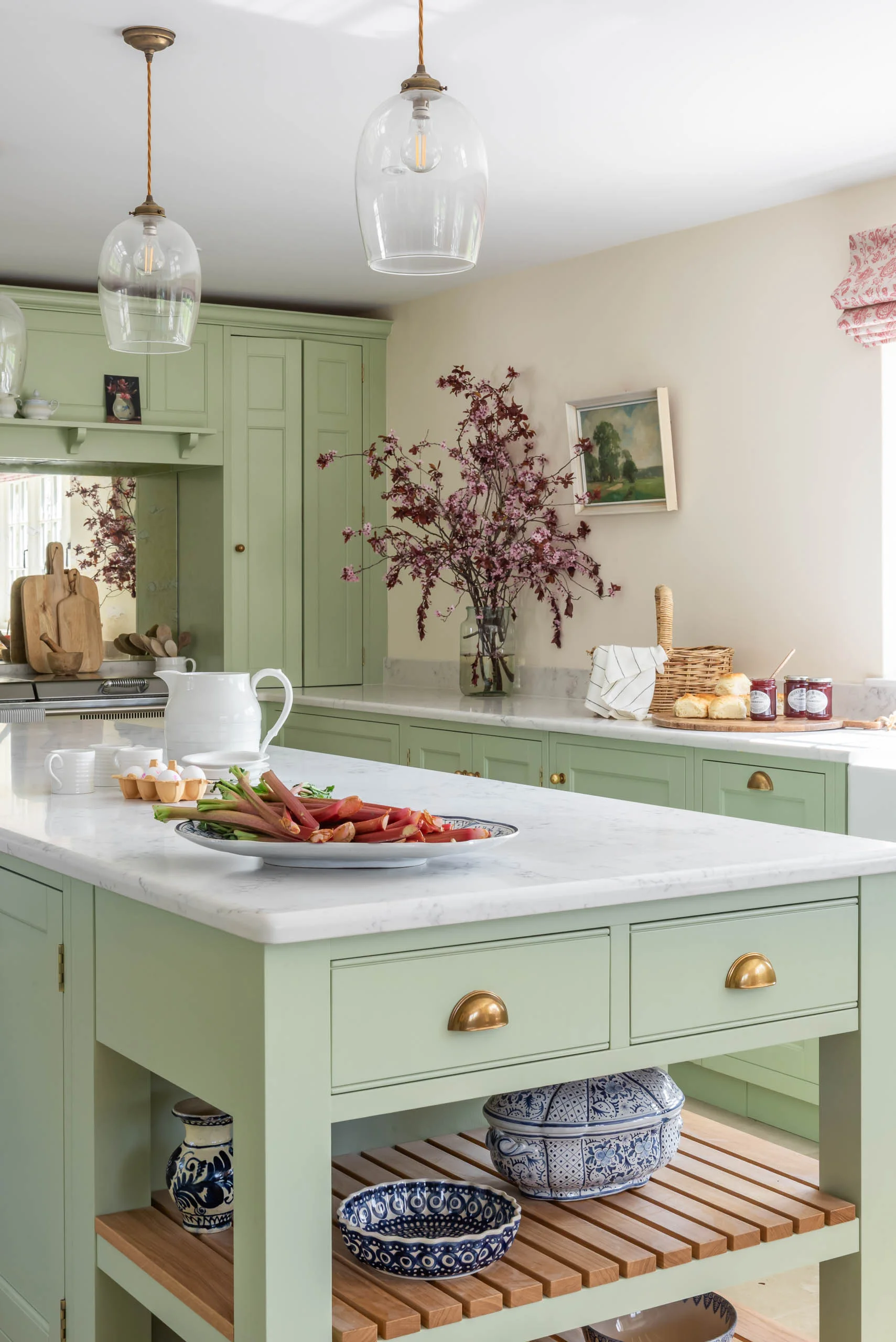
Why green kitchens have outlasted grey and navy
Most kitchen colours arrive, peak and fade within a few years. Grey peaked in 2020, when close to 20,000 people a month were searching for a grey kitchen, and by 2025 that was down to around 3,650. Navy peaked a year later and lost two thirds of its searches. Green climbed to around 10,000 a month in 2021 and stayed there, and it is still the colour most people look for.
We think the reason is simple. Green sits beside the materials a kitchen is already made of, oak, stone, brass and brick, so it reads as part of the house rather than a decorating decision laid on top of it.
Sage green kitchens
Sage is the shade most people picture first, a muted, grey-leaning green that behaves almost like a neutral. Little Greene’s Sage Green runs through the kitchen and bootility at Innisfree House, an Edwardian home, against a dark-stained oak island made in our workshop. Little Greene note that the Victorians chose it “on account of their repose to the sight”, and that is still why people choose it.
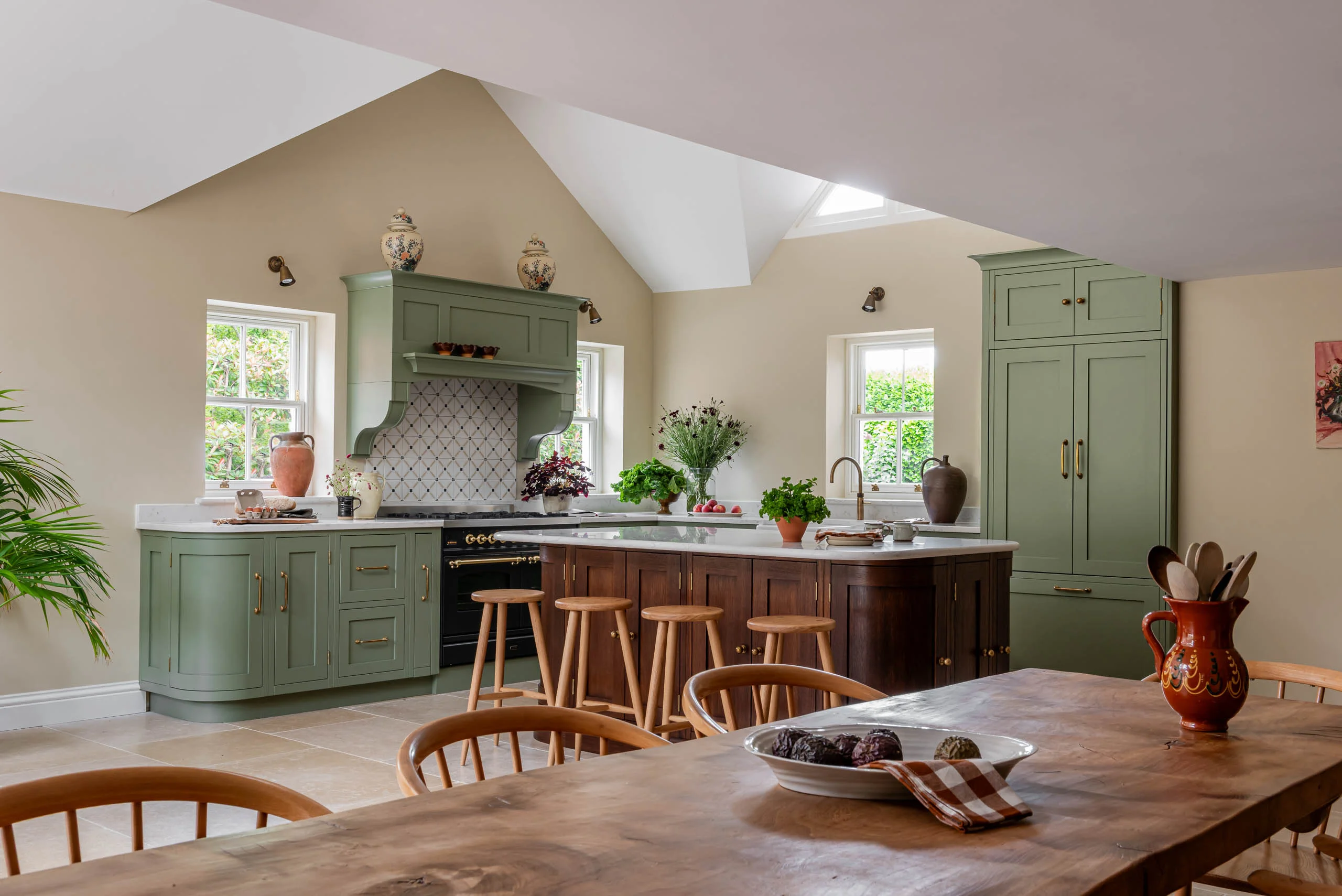
At The Wealden Green Kitchen, a listed 16th-century farmhouse, the owners tested many greens before settling on Farrow and Ball’s Vert de Terre, a soft green with a blue undertone, because it felt calm and enduring. Little Greene’s Boringdon Green, a soft grey green taken from the dining room at Saltram House in Devon, covers the whole of Sycamore House, laundry included, with polished brass hinges and a Calacatta Gold quartz worktop.


Dark green kitchens
Deep greens appear across our recent projects, on islands and throughout whole kitchens. At Hearthstone Cottage, a Cotswold stone home, Farrow and Ball’s Minster Green covers a three-metre island under a steel roof lantern while the perimeter cabinetry stays in Old White. Limestone flagstones, antique brass and a hand-glazed green tile splashback do the rest.

At Mosswell House, an inter-war home, Little Greene’s Olive Colour covers the Shaker cabinetry in a compact galley and continues onto a breakfast pantry in the adjoining dining room. Burnished brass handles bring warmth to the green, while pale leathered quartzite worktops and a white apron-front sink keep the window side light. The pantry takes the kettle and toaster out of the galley, freeing up preparation space without an island.

The Gables, a 1920s terrace in Palmers Green, is painted throughout in Farrow and Ball’s Beverly, a clean forest green that the makers say can “feel even greener in bright daylight or more conservative in lower light”. It was chosen so a new glazed extension with black steel doors would not read as a modern box at the back of the house.
Little Greene’s Harley Green, a deep blue-based green first used at Wimpole Hall, gives the St Albans Garden Kitchen its teal edge against black steel, reeded glass and oak.


Grey green, fresh green and two greens together
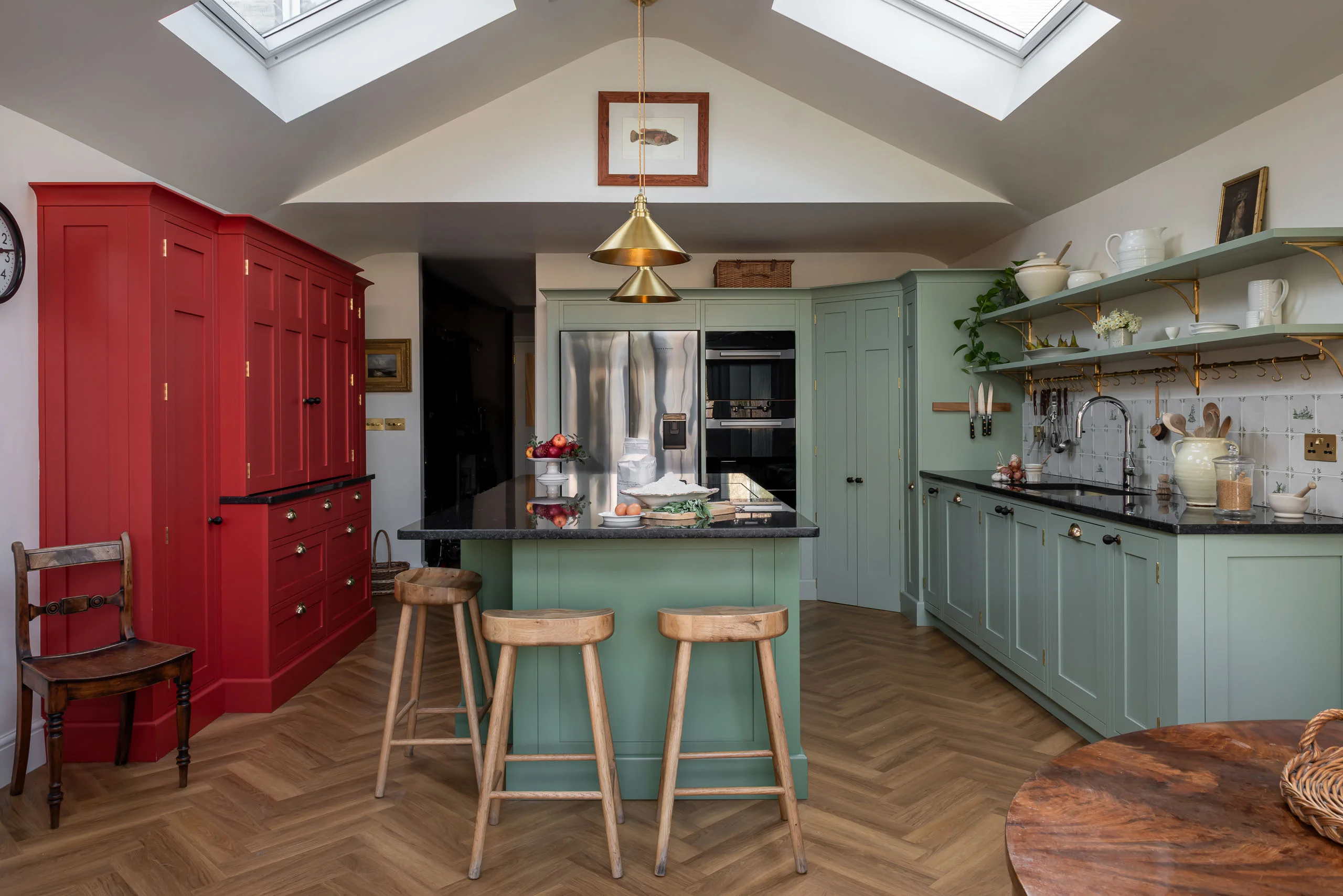
Grantchester Revival, a Victorian terrace in Cambridge, uses two greens at once. The wall run and corner larder are in Little Greene Boringdon Green, the island in Farrow and Ball Calke Green, a shade deeper and cooler, with dark granite running through both so they read as one family. A breakfront cupboard, colour matched in our workshop to a red the client brought in, houses the coffee machine and drinks.
At the fresh end of the range is Farrow and Ball’s Yeabridge Green, found behind a gun cupboard in a Georgian farmhouse in Somerset. It covers the island at The Old House, with the rest of the cabinetry in James White, an off-white with a slight green cast. A roof lantern directly above is what lets a colour this strong carry the room.


Choosing a green for the light in your kitchen
Green shifts with light more than most colours, because every green carries a blue or a yellow undertone and daylight pulls it one way or the other. Farrow and Ball note that “northern light tends to bring out the cooler tones within a colour”. Little Greene’s creative director Ruth Mottershead writes that colours in north-facing rooms “tend to appear consistently flatter and cooler”, while warm southern light can make them “appear more yellow”.
So a blue-based green such as Vert de Terre or Harley Green can turn grey and flat in a north-facing room, and a bright one such as Yeabridge Green can look yellower than the sample in a south-facing one. Off-whites are not immune either. Old White reads as a subdued green in north light and as a soft grey in a bright room.
Three rules, and both paint makers say the same. Paint two coats onto a large sheet of card, not a patch on the wall, so you can move it from wall to wall. Look at it over a day or two, in daylight and under the lights at night, and in the darkest corner as well as the brightest. And in a north-facing room, start a shade warmer or deeper than instinct suggests.

What goes with a green kitchen
Worktops. Both ends work. Dark granite grounds the two greens at Grantchester and gives the brass something solid to sit against. Pale marble-effect quartz lifts the green at Sycamore House and Innisfree and bounces light back into the room. The Gables goes a third way, with an island top in a sintered stone that mimics oxidised copper and picks up the warmth in Beverly.
Oak. It turns up beside green in nearly every one of these kitchens, as an island at Innisfree, as shelving at Sycamore House and St Albans, and as the floor at The Gables. Green and oak is the pairing we would start from if a client were undecided.
Handles. Brass appears on almost every green kitchen we make, polished at Sycamore House, antique at Hearthstone Cottage, unlacquered at The Old House. Brass and the warmer greens share golden undertones, which is why they sit so easily together. Black works alongside the deeper greens, mixed with brass at Grantchester and as steel and overhead cabinets at St Albans, and brushed nickel gives Beverly a cooler, more modern edge at The Gables.
Walls. The safest wall colour is a soft off-white, and the ones that recur through these projects lean the same way as the cabinetry. James White has a hint of green in it, Old White is a soft grey green, and Slipper Satin has a touch of warm yellow and no cool blue.
Second colours. Pink and green is a pairing both paint makers recommend, and red does the same job with more weight, as Little Greene’s Arras does on the drinks area at Innisfree and the bespoke red breakfront does at Grantchester.
Floors and tiles. Limestone flagstones at Hearthstone, aged stone porcelain at The Old House, herringbone parquet at Grantchester and Versailles oak at The Gables all sit beside green here, and the common thread is a warm, natural surface. Hand-glazed green tiles at Hearthstone, Zellige at St Albans and Delft-style tiles at Grantchester show that pattern and green cabinetry can share a room without competing.


Why green looks different hand-painted
A fully sprayed finish is flat and uniform. Our doors are primed and then brushed by hand with a water-based paint, which leaves a slight texture that catches the light unevenly and gives the colour depth. On an in-frame door, where the door sits inside a visible frame like a piece of furniture, the shadow lines around each panel do the same job.
Any colour can be chosen or matched, not only the ones on a chart, and every kitchen leaves with a pot of its own paint. A small chip can be touched up at home, and if taste changes years later the cabinetry can be repainted rather than replaced. That is the honest answer to whether green will date.

See the quality in person
Every White Kitchen Company kitchen is made to order in solid hardwood, in-frame, with dovetailed oak drawers, hand-painted in the colour you choose, and backed by a lifetime guarantee when installed by us. The project gallery has the full photography for every kitchen here.
Photographs only go so far with a painted finish. Book a showroom visit to see the cabinetry up close and talk through your own project with one of our designers, or if Northamptonshire is a long way off, get in touch and we can start remotely with a consultation call.

Frequently asked questions
Is a green kitchen a good idea?
Yes, provided the shade is chosen for the room rather than from a photograph. Green sits naturally beside oak, stone, brass and brick, which is why it suits period homes and new extensions alike. Green appears across our recent projects, from sage to deep olive, and searches for green kitchens have held steady for five years while grey, navy and white fell away.
What colour goes with a green kitchen?
Soft off-whites are the safest wall colours, and ones that lean the same way as the cabinetry work best, such as Farrow and Ball James White with its hint of green or Old White, a soft grey green. Brass suits every green because both share warm golden undertones, black sits well with the deeper shades, and brushed nickel gives a forest green a more modern feel. Pink and green is a pairing both Farrow and Ball and Little Greene recommend, and a deep red does the same job with more weight.
Which worktop goes with a green kitchen?
Both ends of the spectrum work. Dark granite grounds a mid or deep green and gives brass hardware something solid to sit against. Pale marble-effect quartz lifts a green and reflects light back into the room. Oak, as a worktop, shelving, an island or a floor, appears beside green in nearly every kitchen we have made in the colour.
Which green is best for a north-facing kitchen?
Both Farrow and Ball and Little Greene note that north light brings out the cooler, flatter tones in a colour, so a blue-leaning green can turn grey in a north-facing room. Start a shade warmer or a shade deeper than instinct suggests, for example a deep green such as Farrow and Ball Minster Green rather than a pale blue-based one, and test two coats on a large sheet of card in the darkest corner of the room, in daylight and under the lights at night.
Will a green kitchen go out of fashion?
Every colour dates eventually, but the greens used on cabinetry today are mostly historic colours, several taken directly from 18th and 19th century houses, that have been in and out of favour for two hundred years. A hand-painted kitchen can also be touched up or repainted in a new colour without replacing the cabinetry, which makes the question far less important than it is for a sprayed or laminate finish.